Wasn't Elder Holland's talk on depression this weekend amazing??? I love General Conference. I have been looking for a talk like Elder Holland's for a long time. And he just nailed everything on the head. His talk was much needed for a lot of people. If you didn't get a chance to watch it, here is the link to it (I had trouble trying to download it, so this is plan B).
http://www.lds.org/general-conference/watch/2013/10?lang=eng&vid=2722351290001&cid=10
Monday, October 7, 2013

Sunday, August 25, 2013
Medication and Therapy
Recently I've had a couple of people ask me about my thoughts on using medication and therapy/counseling as a way to treat depression. There was a similar vein of concern in the people I talked with--the stigma associated with these methods is not often a good one. Many people know of instances where an individual reacted negatively to the medication in some way, such as making their depression feel worse (even to the point of acting suicidal), or they had to deal with frustrating side effects, such as feeling extra tired, or they may feel that they shouldn't need to rely on medication to cope.
Many are also hesitant to see a counselor. Some of these reasons may include bad experiences with a past counselor, feeling like your issues aren't big enough to warrant seeing a counselor (after all--"There are so many people with worse problems!"), or they are simply embarrassed to go, etc.
My opinion on these issues in a nutshell is that I am a total believer in utilizing antidepressant medication as well as seeing a counselor. But let me expound a little and share my experiences with these two subjects.
On medication:
My experience: It is true that sometimes, but certainly not every time, nor in most cases (that I know of), a medication will initially lead to a person feeling worse than before they even took it. This actually happened to me on my mission. The medication I was prescribed immediately made me feel like my depression took a nosedive. I completely lost my appetite, I couldn't sleep, and suicide honestly felt tempting--not because I wanted to die, but because I was so desperate to do anything to stop feeling the way I did. We called up the mission psychiatrist and he told me to stop taking my medication. When I came home from my mission, my family doctor put me on a different medication that was a lot gentler. I was told that I would start to feel a difference in about 2-3 weeks. So about a month later, I did a self-inventory and realized that, yes, I felt a LOT better. The change had been so gradual that I hadn't really noticed it until I did my self-evaluation. It felt wonderful. A couple of months later I went back to BYU to continue my college education and after a couple months I felt like I needed a change of medication again. What I was on had helped tremendously, but I still felt like there was room for improvement. I talked to a doctor at the Student Health Center and I was put on a new medication. This last antidepressant helped even more than the previous one had. It felt incredible. However, this medication gave me the unlucky side effect of feeling exhausted all the time. I was so tired that I thought there must be something else physically wrong with me, so I went and got tested for sleep apnea (that was interesting, let me tell you) as well as mono. I had neither, and concluded that it must have been from my medication. But I felt, and still feel, that I would MUCH rather be tired than depressed, and so I stayed on that medication until I finally felt like I didn't need it anymore and quit using meds entirely.
My advice: So my advice on this matter is that it is worth trying. If it makes you feel worse, TALK TO YOUR DOCTOR immediately and get off of it and ask for something different. Not everyone reacts the same to a medication. The antidepressant that made me feel worse has worked for a lot of other people, and a friend told me that the one that I felt worked the best for me made her feel worse and she needed something different. Also, don't be discouraged if you don't notice a difference right away. 2-3 weeks can feel like forever, but it is worth the wait. If after a month and a half or so you still feel exactly the same, I would talk to your doctor and see if you can try something else. Some people don't get their "match" right away. That's okay. It's frustrating, but it doesn't mean anything is wrong with you. Just ask for something different if you feel like you need to. It is totally worth it when you find one that works. There are TONS of different antidepressants out there. Some are more catered to those with anxiety, some more for depression. Talk to your doctor and he/she can give you advice on what may be a good match for you. Also, if you have been on a medication for awhile, don't EVER quit it cold turkey. If you are going to quit taking it, do it gradually, otherwise you could have some bad physical side effects (shaking, feeling faint, that kind of thing.) Talk to your doctor about it, as each medication could be different.
On therapy/counselors/shrinks/whatever you want to call it:
My experience: I have seen counselors in two different periods of my life--the first was during my Sophomore year of college when I had dysthymia (the less intense form of depression), and the second was after my mission when I came back to school. I saw each of them for about six months. I started seeing a counselor at the recommendation of the doctor that diagnosed me with dysthymia. My initial feelings were of embarrassment and apprehension. I had grown up believing that only people with major problems (that I would never have, right??) went to counseling. When I started my sessions, I was embarrassed and felt like the other people in the waiting room were judging me and I was always grateful that I never ran into anyone I knew. I was also terrified to tell my parents, because I had no idea how they would react. I learned the following really quickly: counselors are there to help, whether your problems be big or small. They provide insights that you don't have and they are trained to help people. All kinds of people. Including you. I also realized that the other people in the waiting room were probably feeling just as painfully self-aware as I was, and that they were probably worrying too much about their own issues to wonder what mine were. I also found that my parents were very supportive. My mom told me that she was glad I was going because our emotional health is just as important as our physical health. I took a lot of comfort in that and never forgot it.
My first visits with each counselor was more of an initial "get-to-know-you" session rather than me venting about all my problems. I was not on any medication while I saw my first counselor, nor did I really need any at that time. Having the counselor was enough at that point in my life. During my second "episode," we'll call it, I was also on medication, because my depression was a lot stronger then. I felt like having both resources was extremely helpful for me then. Both of my counselors were male, and my second counselor had served a mission in Bolivia (I had served in Paraguay, located just below Bolivia). Since a lot of what I needed to talk about and resolve centered on my mission, I felt like he could relate to my concerns. I quit seeing each of them when they and I both felt like I was at a good place in my life and no longer needed therapy. I continued with my medication for some time after I had quit seeing the second counselor, but when I felt like there was nothing chaotic going on in my life and that I was in a good place emotionally, I stopped the medication as well. I have not had a need for it since. That could always change, but my goal was never to be on medication for forever, but just long enough to get back "on track."
My advice: Counselors rock. But not everyone is going to have the same experience with the same psychologist. If you don't feel like you click with your counselor after some sessions, then there is no reason to not switch. When I started seeing a counselor, he told me right off the bat that if I wanted to switch to see someone else (like a woman counselor, or just someone new) then that was totally fine. This is your money and your life, so there is absolutely nothing wrong with switching to someone that you like better. But remember that the first session is usually an in-take kind of session and not a typical one. So don't quit after the first one--give it a chance. Also remember that going to therapy will not immediately fix things. It takes time. They often are trying to help you make some paradigm shifts in your life and that takes time. But it is worth it. It is so nice to see someone that is professionally trained to help you deal with life, who won't judge you, and who isn't going to call your mutual friend to blab about things you want to keep personal. Also, your counselor can only help you as much as you are willing to open up to them. They are not mind-readers, so don't expect them to be. The more you open up to them, the more information you are giving them, and thus more tools for them to help you.
Also, don't confuse counselors and friends. Friends are not equipped in the same way counselors are. And counselors are not your best bud that you call all the time. Counselors are usually temporary relationships. And don't treat a friend like you would a certified therapist. It is wonderful to have friends to talk to. But if you are consistently telling a lot more to your friend(s) than your counselors about serious issues, then I think that's a little backwards. Venting is one thing. We all need friends to vent to, talk to, and relate to, especially when we find someone that has had similar experiences. Having a friend to talk to who also had dealt with depression was one of the biggest blessings of my life. We got to share experiences and help each other and it was something that really helped me. But she was not my counselor. There was a difference. Be wise. That's all I will say about that, because I'm not exactly sure how else to phrase what I mean.
In conclusion, using medication or therapy does not make you a bad person. It doesn't categorize you into some terrible group of people, and it doesn't mean you are being overly dramatic. These are tools that I honestly believe come from our Heavenly Father, and I believe He is proud of us when we take steps that will help us move forward. Best of luck on your journey.
~hugs~
Tuesday, January 22, 2013
Long overdue update
Well folks, it has been almost a year since I've touched this blog. I didn't forget about it. I just stopped getting inspiration for it. But for me, that is a good thing, because most of my inspirations came from bouts of depression.
So I thought I would give an update.
In March of last year, I weaned off of my antidepressants. I haven't touched any since. It felt like a huge victory. I haven't been without an occasional bout, but I haven't needed to rely on medication any more. And it feels wonderful.
In April, I met my half brother for the first time in person. It was amazing.
In June I started dating this really awesome guy.
In August I got released from being the RS President and was called to be the Sacrament Meeting pianist. My dream calling!
Yesterday, that really awesome guy and I celebrated one month of being married.
Life has been incredible. Now, I feel like I should mention, last year I went through some really ugly experiences. But I don't want to mention them here. I am trying my best to move past them. Because my life is awesome right now. And I don't want to taint my "now" with the past.
But my thoughts keep reverting to this blog, especially as I continue to meet these wonderful people I know that are going through depression, anxiety, and other painful things they would rather not have to deal with. And so I made a New Year's Resolution.
I want to make this blog into a book.
I have thought about this for awhile. I even have an outline. I am not always good at reaching really big goals like this. But I am feeling really determined to make this one happen. I am not giving myself a deadline. I'd like to be pretty much done with it by the time the year ends, but knowing me, something big and unexpected could happen and make this go on pause for a bit. But this is the goal.
That said, I want to know if there is anything you would like me to talk about in my book that I may or may not have mentioned in this blog. Like any questions you have that you want answered. Or any personal experiences of yours or mine that you'd like me to share.
Anyway... I hope that all of you are doing really well. Like REALLY well. Because amidst heartache, pain, trials, mental anguish, feelings of loneliness and sadness...life is beautiful.
HUGS
Monday, February 20, 2012
The different kinds of depression and my experiences with them
For those who are unfamiliar with depression, there are actually 2 main kinds of depression: major depressive disorder and dysthymia.
Brief explanation:
Dysthymia: dysthymia would be considered the "lesser" of these two forms of depression. The feelings of depression are not quite as strong, but they last much longer--often 20-30 years.
Major Depressive Disorder: This is a much stronger form of depression, but it usually lasts over a period of months instead of several years. However, those with dysthymia may also get bouts of major depressive disorder.
I was diagnosed with dysthymia when I was 19 and in my second year of college. Yay for me. I felt like the biggest loser at the time because in my perspective it meant something was "wrong" with me. I'm glad I'm way beyond that phase now. I signed up for a counselor, who was awesome, and was able to help me overcome some issues, like assertiveness, which in turned helped boost my self-esteem immensely. After about 6 months of therapy my counselor and I decided that I was at a good place and didn't really need counseling any more. What a great feeling that was! I wasn't perfectly happy all of the time of course, but I was emotionally in a pretty good place.
Enter mission. Holy Hannah. Enter major pressures from everywhere and everyone, plus my already existing dysthymia, incredibly hard work, a mission experience quite different that I had imagined and I had just the right recipe for a pretty bad major depressive episode. Woooooah mama. Enter anti-depressants that were not right for me. Rollercoaster plummet. Hoooo-wee. I consider that the darkest time of my life. There was no one to blame for it. It's what happened, I can't change that, but I can recognize it for what it was: depression. What it was not: anyone's fault. And you know what, as horrible and dark as that time of my life was, I have grown and learned from it. And I am doing soooo much better. I wouldn't wish the experience I had on anyone, but I'm grateful that Heavenly Father trusted me enough to give me such an immense trial, even if it did push me to my most outer limits.
It's been almost a year and a half since I've returned from my mission. When I got back, I got put on different medication that was better for me and I began my slow healing process. I can't believe how far I've come since then, with the help of more therapy from another awesome therapist, meds, and the support of some really incredible people. And above all, the Atonement. It's incredible that Christ knows exactly what I go through, and He knows how to help me and WILL help me as I put forth all the effort that I have as well.
I still struggle with dysthymia and I'm still on medication, although when I reach a relatively stress-free part of my life, I will try to take myself off of them. Everyone has their crosses to bear, and this is one of mine. And you know, maybe I'm completely crazy, but I'm actually incredibly grateful for it. Because it has made me so much more understanding and compassionate to others, matured me, refined me, and prepared me for future burdens I would have. It definitely prepared me for my current church calling as a Relief Society president in a single adult ward....turns out there are quite a lot of sisters that struggle with depression...and I can actually make some kind of positive impact in their lives.
I am so blessed.
Sunday, February 12, 2012
My art project...finally
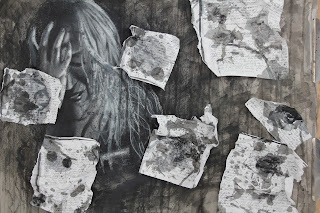
Okay, so here are the art pieces I made that I mentioned in an earlier post. Each piece is about a different mental disorder, and of a real person that has that disorder.
1) Depression.
 ,


1) Depression.

This one is actually a self portrait. I took journal entries from my mission from times where I really struggled, laid them on the ground, and then dripped ink from the art piece, which then dripped onto the journal entries (like tears...get it...?) Mediums used: copied paper, ink, conte crayon, charcoal.
2) Eating Disorder
 ,
From here on out I will not identify who the people are, in order to protect identities. This one is a pretty literal piece--I used nail polish (because it is a "beauty item") to write down thoughts that a person with an eating disorder might or do have. The papers scattered about the piece are the nutrition labels of various food items, with the calorie count circled. The scale on the top is real, and the "belt" of the shirt is measuring tape. Materials used: wood base, shirt, scale, nail polish, various mixed media.
3) Depression (again)


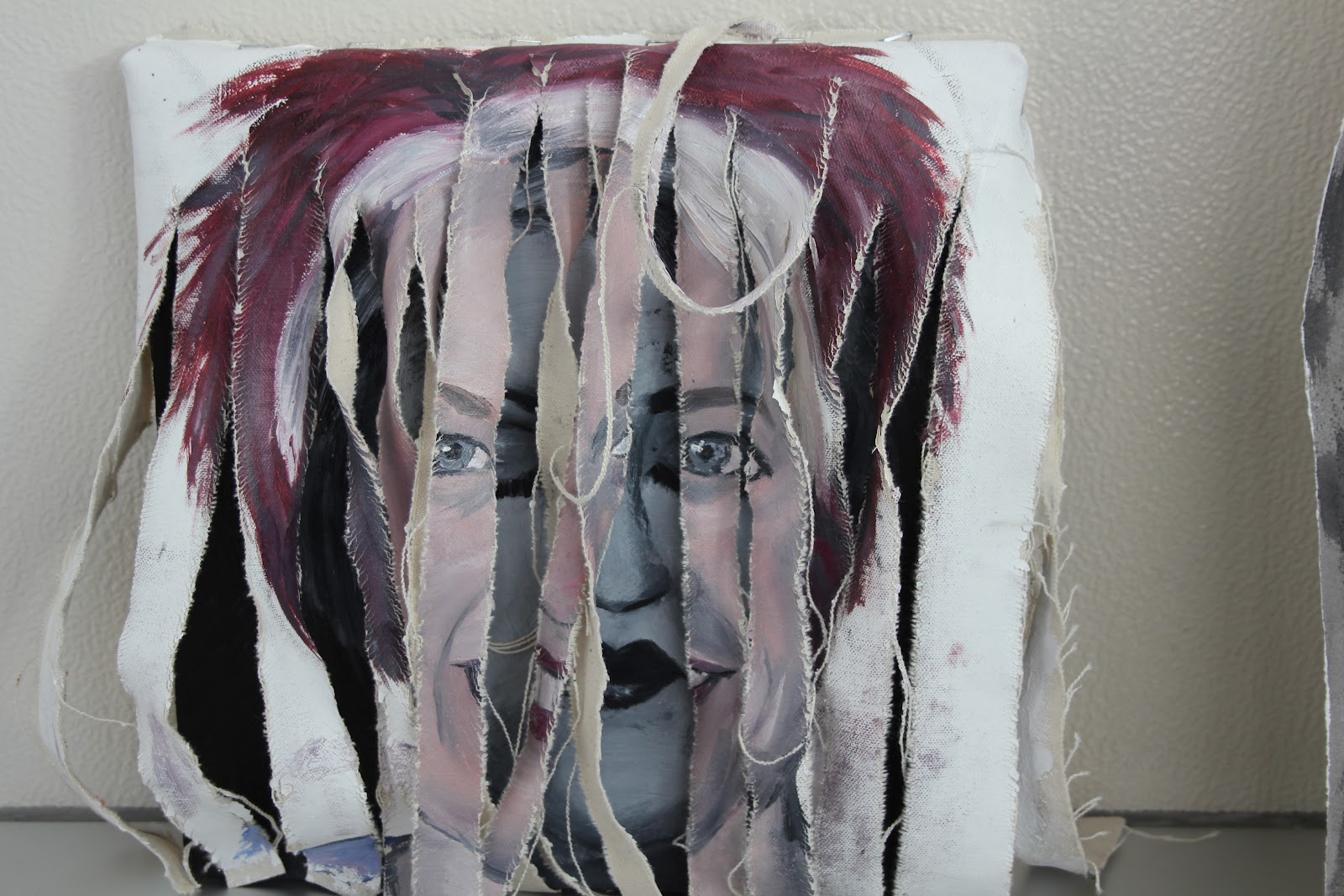
These are various images of the same piece. I wanted to depict how often those with depression show a happy exterior, but feel miserable underneath. To me, that doesn't necessarily mean that you're "faking" it, but simply that people often do not see what a person with depression is actually feeling.
I did a 4th piece on PTSD (post traumatic stress disorder) as well. However, it's a pretty heavy piece, and I don't feel comfortable posting it in a public place as of now. Anyway...I would love to keep making more, but it will have to wait until I have more free time. Hope you enjoyed!
Monday, January 30, 2012
DON'T JUST SIT THERE
Here is some hard but honest truth about depression--if you do nothing to try to change how you feel, then you will still feel miserable. And sometimes worse. If you want to feel happier, it requires action on your part. No one else can cure it. Of course, having the support of friends helps, but it's like that analogy of hanging on other peoples' testimonies--you can only do that for so long before you have to have your own. So it is with your personal happiness--the happiness and support of other people can help, but it can never replace what you are actually feeling.
So...what is there to do? GET HELP. If you have been feeling miserable for a long time for no reason, GET HELP. You are doing yourself no favors by wallowing in self-misery and feeling like you deserve to feel that way. No, you don't deserve to feel that way. It's time to show yourself some self-respect and ACT. This usually means going to a doctor. Yes, it is scary, especially if it's your first time. There is unfortunately a bad stigma often associated with seeking professional help for depression because it supposedly means, "something is wrong with you." That's a load of crap. What it REALLY means, is that you are showing yourself that you care enough about your well-being to take care of yourself, including your mental health.
What kind of doctor? Well, it is best if you meet with both a medical doctor that can prescribe you some great meds, in addition to seeing a counselor/therapist. THEY ARE SO GREAT!!! Honestly, I would never have progressed as much as I have without the great counselor I had at BYU, in addition to finding a medication that was right for me. I realize that counselors can be expensive (unless you're a BYU student--it's FREE!!! YES, FREE!!!!!!!!!!), but finding a good counselor is WORTH IT. I will write some other posts that elaborate more on therapists and anti-depressant meds another time.
That said, you need to DO something about your depression. Yes, that requires action. It requires making a phone call, or stepping into an unfamiliar doctor's office. Yes, that can be scary or very uncomfortable. But no one there is going to look at you and be like, "Oh gee, I wonder why she/he is here? They must have ISSUES. What a LOSER." No one is thinking that. In fact, if you're in the counselor's office, the other people sitting there are there for the same reasons you are! You are not alone.
So, let me sum up the important things really quick:
1) If you don't do anything to change the way things are, then they will not get better. End of story.
2) Show yourself some self-respect and realize you DO deserve to be happy, and that YOU should DO something about it.
3) Don't expect immediate change--you've taken an important and huge step, but there is still a road to travel. Progress is gradual, and you need to be patient with yourself, and with your doctors, who really do have your best interest in mind. Give it all some time--medication usually take a few weeks before you notice a difference, and counseling takes several sessions so you can apply what you learn and change any unhealthy paradigms that you've been stuck with for awhile.
4) IT'S WORTH IT. IT IS WORTH THE EFFORT TO BE HAPPY
5) Oh, and keep praying to God for help and reading your scriptures during all of this. He will help guide you, provide comfort, and the scriptures provide a solid source of truth for you to lean on, especially when it comes to the Atonement and our Savior's love for YOU.
Hang in there. You are doing better than you think.
Saturday, December 24, 2011
30 Things to Stop Doing to Yourself
I read this article from here and thought it was totally applicable for this blog. There are so many truths here. Love it!
Stop spending time with the wrong people. – Life is too short to spend time with people who suck the happiness out of you. If someone wants you in their life, they’ll make room for you. You shouldn’t have to fight for a spot. Never, ever insist yourself to someone who continuously overlooks your worth. And remember, it’s not the people that stand by your side when you’re at your best, but the ones who stand beside you when you’re at your worst that are your true friends.
Stop running from your problems. – Face them head on. No, it won’t be easy. There is no person in the world capable of flawlessly handling every punch thrown at them. We aren’t supposed to be able to instantly solve problems. That’s not how we’re made. In fact, we’re made to get upset, sad, hurt, stumble and fall. Because that’s the whole purpose of living – to face problems, learn, adapt, and solve them over the course of time. This is what ultimately molds us into the person we become.
Stop lying to yourself. – You can lie to anyone else in the world, but you can’t lie to yourself. Our lives improve only when we take chances, and the first and most difficult chance we can take is to be honest with ourselves. Read The Road Less Traveled .
Stop putting your own needs on the back burner. – The most painful thing is losing yourself in the process of loving someone too much, and forgetting that you are special too. Yes, help others; but help yourself too. If there was ever a moment to follow your passion and do something that matters to you, that moment is now.
Stop trying to be someone you’re not. – One of the greatest challenges in life is being yourself in a world that’s trying to make you likeeveryone else. Someone will always be prettier, someone will always be smarter, someone will always be younger, but they will never be you. Don’t change so people will like you. Be yourself and the right people will love the real you.
Stop trying to hold onto the past. – You can’t start the next chapter of your life if you keep re-reading your last one.
Stop being scared to make a mistake. – Doing something and getting it wrong is at least ten times more productive than doing nothing. Every success has a trail of failures behind it, and every failure is leading towards success. You end up regretting the things you did NOT do far more than the things you did.
Stop berating yourself for old mistakes. – We may love the wrong person and cry about the wrong things, but no matter how things go wrong, one thing is for sure, mistakes help us find the person and things that are right for us. We all make mistakes, have struggles, and even regret things in our past. But you are not your mistakes, you are not your struggles, and you are here NOW with the power to shape your day and your future. Every single thing that has ever happened in your life is preparing you for a moment that is yet to come.
Stop trying to buy happiness. – Many of the things we desire are expensive. But the truth is, the things that really satisfy us are totally free – love, laughter and working on our passions.
Stop exclusively looking to others for happiness. – If you’re not happy with who you are on the inside, you won’t be happy in a long-term relationship with anyone else either. You have to create stability in your own life first before you can share it with someone else. Read Stumbling on Happiness .
Stop being idle. – Don’t think too much or you’ll create a problem that wasn’t even there in the first place. Evaluate situations and take decisive action. You cannot change what you refuse to confront. Making progress involves risk. Period! You can’t make it to second base with your foot on first.
Stop thinking you’re not ready. – Nobody ever feels 100% ready when an opportunity arises. Because most great opportunities in life force us to grow beyond our comfort zones, which means we won’t feel totally comfortable at first.
Stop getting involved in relationships for the wrong reasons. – Relationships must be chosen wisely. It’s better to be alone than to be in bad company. There’s no need to rush. If something is meant to be, it will happen – in the right time, with the right person, and for the best reason. Fall in love when you’re ready, not when you’re lonely.
Stop rejecting new relationships just because old ones didn’t work. – In life you’ll realize that there is a purpose for everyone you meet. Some will test you, some will use you and some will teach you. But most importantly, some will bring out the best in you.
Stop trying to compete against everyone else. – Don’t worry about what others doing better than you. Concentrate on beating your own records every day. Success is a battle between YOU and YOURSELF only.
Stop being jealous of others. – Jealousy is the art of counting someone else’s blessings instead of your own. Ask yourself this: “What’s something I have that everyone wants?”
Stop complaining and feeling sorry for yourself. – Life’s curveballs are thrown for a reason – to shift your path in a direction that is meant for you. You may not see or understand everything the moment it happens, and it may be tough. But reflect back on those negative curveballs thrown at you in the past. You’ll often see that eventually they led you to a better place, person, state of mind, or situation. So smile! Let everyone know that today you are a lot stronger than you were yesterday, and you will be.
Stop holding grudges. – Don’t live your life with hate in your heart. You will end up hurting yourself more than the people you hate. Forgiveness is not saying, “What you did to me is okay.” It is saying, “I’m not going to let what you did to me ruin my happiness forever.” Forgiveness is the answer… let go, find peace, liberate yourself! And remember, forgiveness is not just for other people, it’s for you too. If you must, forgive yourself, move on and try to do better next time.
Stop letting others bring you down to their level. – Refuse to lower your standards to accommodate those who refuse to raise theirs.
Stop wasting time explaining yourself to others. – Your friends don’t need it and your enemies won’t believe it anyway. Just do what you know in your heart is right.
Stop doing the same things over and over without taking a break. – The time to take a deep breath is when you don’t have time for it. If you keep doing what you’re doing, you’ll keep getting what you’re getting. Sometimes you need to distance yourself to see things clearly.
Stop overlooking the beauty of small moments. – Enjoy the little things, because one day you may look back and discover they were the big things. The best portion of your life will be the small, nameless moments you spend smiling with someone who matters to you.
Stop trying to make things perfect. – The real world doesn’t reward perfectionists, it rewards people who get things done. Read Getting Things Done .
Stop following the path of least resistance. – Life is not easy, especially when you plan on achieving something worthwhile. Don’t take the easy way out. Do something extraordinary.
Stop acting like everything is fine if it isn’t. – It’s okay to fall apart for a little while. You don’t always have to pretend to be strong, and there is no need to constantly prove that everything is going well. You shouldn’t be concerned with what other people are thinking either – cry if you need to – it’s healthy to shed your tears. The sooner you do, the sooner you will be able to smile again.
Stop blaming others for your troubles. – The extent to which you can achieve your dreams depends on the extent to which you take responsibility for your life. When you blame others for what you’re going through, you deny responsibility – you give others power over that part of your life.
Stop trying to be everything to everyone. – Doing so is impossible, and trying will only burn you out. But making one person smile CAN change the world. Maybe not the whole world, but their world. So narrow your focus.
Stop worrying so much. – Worry will not strip tomorrow of its burdens, it will strip today of its joy. One way to check if something is worth mulling over is to ask yourself this question: “Will this matter in one year’s time? Three years? Five years?” If not, then it’s not worth worrying about.
Stop focusing on what you don’t want to happen. – Focus on what you do want to happen. Positive thinking is at the forefront of every great success story. If you awake every morning with the thought that something wonderful will happen in your life today, and you pay close attention, you’ll often find that you’re right.
Stop being ungrateful. – No matter how good or bad you have it, wake up each day thankful for your life. Someone somewhere else is desperately fighting for theirs. Instead of thinking about what you’re missing, try thinking about what you have that everyone else is missing.
...
Subscribe to:
Posts (Atom)